Showing posts with label morality. Show all posts

Tuesday, December 13, 2011

Lobstering: The Social Animal

If this whole blog is about cultivating long distance friendships, and/or strengthening relationships, might we, in this context, refer to "putting intentional effort into our relationships, be they near or far" as "Lobstering"? eh? What do you say? I think it'll become a thing. 


So I recently finished reading an awesome book called The Social Animal by David Brooks. I really try to be open minded about what I read, and no matter how I feel at the start of a book, I really push myself to finish it to give it a fair try - holding out hope for those bad ones that there will be a redeeming twist at the end. Sometimes, I'm better off just letting the book go, telling it, "I just want to be friends." Other times, I really don't agree with all that the book has to say or all that it purports, but overall, I might find it sufficiently edifying or at least thought provoking that I am still likely to recommend it to the right person who might also appreciate it. In other words, I actually do want to be "friends" with those books. VERY very rarely, (or ever?) do I come across I book that does not include a disclaimer, "I don't necessarily like everything s/he has to say, but . . ." I simply can NOT find such a complaint about The Social Animal. It does not start off too slow, it does not end poorly, and I don't think I can disagree with him on any idea he seems to be trying to promote. I think I have found a book with whom I am no longer content to just be friends. I am in love. Consider me stunned.


In this quasi-novel, Brooks is pulling together lots of neuroscience research he finds interesting into the form of a story about two people who manage to have a happy life. I love stories, I love research-digests. Win. win. Throughout the story, he manages to touch on romance, extended adolescence [apparently this is now a life stage called "odyssey"], parenting, vocation discernment, politics, fidelity, morality, learning, nature, religion, creative processes, memory, living the good life, and the integration of the subconscious with reason, all topics I'm regularly energized by. He also, by the way, put forth his own interesting explanations about adults being single into later stages of life, a topic I obviously ponder on a bit (see pages 188-189 of the book for yourself). 


A few of the big take-away's for me were:


1) How much neuroscience is now reinforcing the more feminist viewpoint that who we are and the quality of how we live is strongly determined by the number and health of the relationships we maintain. Furthermore, that I am living in a life stage and era where this is particularly difficult due to our transitory generation:


“Cities have become the career dressing rooms for young adults. They have become the place where people go in their twenties to try on different identities. Then, once they know who they are, they leave. Thirty-eight percent of young Americans say they would like to live in Los Angeles, but only eight percent of older Americans would. Harold’s friends would show up in San Francisco one year and then Washington, D.C., the next. Everything changed except their email addresses.” (p. 188)


2) Martin Luther was right when he said that "Reason is a whore." We can manipulate logic and even science to produce whatever point we want to come out with. Without something more than reason, without acknowledging the power, importance, and value of morality and our emotions, we can not live life fully and our communities will be diminished. Here's a quote I loved:


[p. 286]


3) The questions we ask and the memories we make are going to be the key things that give our lives value as we look back on them.  Here's a great snip-bit along those lines:


[p. 364]


If you have or do check[ed] the book out for yourself, I'd love to know your thoughts. I'll leave you with one of my favorite quotes, the sentences that speak most clearly to the importance of "Lobstering," my Lobsters.


I give The Social Animal by David Brooks a hearty two claws up!


Tuesday, October 18, 2011

Playing the Justice Card

Crowds occupy Wall Street crying out for justice. I am excited for this energy, accountability, and cooperation. I think the groups that keep joining the effort are wise to combine their energies instead of competing against one another to have their lone voice heard above the competition. And who can argue against justice? I heard a journalist say yesterday that the "99%" are actually the "100%" because even the investment bankers and corporate tycoons sympathize with this cause. 


Right now, Justice is a big buzz word, and it is also a powerful trump card. The ace of spades, if you will. And yet, I recently came the understand through some reading, that playing that ace is trickier than it seems. I think these groups may experience more trouble than they anticipate in spelling out just what they mean by "justice." I recently finished two books that speak to this theme in interesting ways. 


First off, Generous Justice by Tim Keller. Keller gets quite a bit of praise, bordering on idolatry, in certain circles. So I  avoided reading him for as long as I could. Thing is, he is good and really worth reading. The other thing is, he doesn't necessarily have all that many original ideas, but he is great at synthesizing key philosophers/thinkers/theologians/etc. Therefore, for a good, current day relevant synthesis on how to be challenged to consider why justice matters, and how to start figuring out what justice actually is, you really should check this out. 


I considered myself someone who had the right ideas and right behavior with regards to justice before reading it, and was both encouraged and challenged to consider things more carefully and figure out how to act more consistently. In case you don't have a chance to read it yourself [it's a nice quick read, so stop making excuses ;) ], one key point he makes that I think is particularly relevant to Occupy Wall Street, is that the roots of our ideas of what justice is are necessarily moral [and therefore religious in at least some sense]. We can not throw around the term "justice" like a sledge hammer or an ace card that lets us win any argument. Justice means differing and often conflicting things to different people. And in a secular society that outlaws public discourse on religious ideas, we can not have a real, resolvable conversation about justice until we start admitting our moral/religious beliefs. I should stop trying to say what he has already spelled out more clearly, so just go read it.


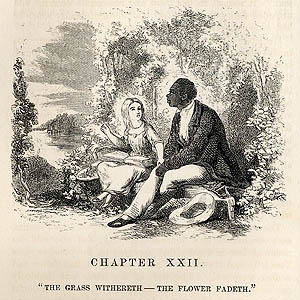
The second book is slightly less direct than Kellers, but I was surprised by how relevant I found it to be. It presents some challenging questions about justice, morality, and integrity in the form of a story. Have you read Uncle Tom's Cabin by Harriet Beacher Stowe? It is a classic I had obviously heard of, and pretended to know about more than once, but I had never read it and I've never heard of it being part of any standard curriculums. But when I found out that Harriet moved to the town I live in because her husband was a professor at the college where my husband is now a professor, I felt an affinity with her and wanted to know more about her and her work. 


Wow. While it may have taken me a little while to get into, it really caught me up once I did. Turns out, it is a collection of real stories Stowe had either witnessed or heard about slaves, slave owners, and northerners who refused to dirty their hands with slave ownership on moral grounds. And while it may not really make for a terribly cohesive overall narrative, the stories are compelling and engaging, and at times tear provoking. While the character development pulls your heart in, these people who come to life before you hold these fascinating conversations. 


It doesn't seem like we need to read a book today to convince us that American plantation slavery is bad (though I realize that modern day slavery is a serious and pervasive problem), but Stowe gets into these subtle particularities of humans engaging with this old problem. She does this in such a way as to challenge my morality today, making me realize that while slavery isn't a moral issue I feel any ambiguity about (perhaps thanks to her - Lincoln credited her as the "the little woman who wrote the book that started this great war."), I have some important questions to consider about what justice really is and how I am living that out. For any christians reading this post, you might be interested to realize how Christ centered the book is. She has some challenging points regarding foreign missions. She also points out that moral issues can not be so simply resolved by deferring to the opinion of your local church, or by playing a trump card like, "the bible says . . . " as there can really be so much division even underneath these seemingly authoritative claims. [watching the God in America documentary series while I read this really enhanced both experiences by the way!] Also, the incredible love for scripture that is woven throughout the book is really beautifully displayed. 


If you have to pick only one of these books, I might actually steer you towards Uncle Tom's Cabin. I think it will get into your heart in a way that might hopefully spur you towards positive change (if you are willing to use some imagination to consider how to apply old points to modern day) in a way that Keller's smart, rational, well articulated arguments won't necessarily do the trick. Also, classics like that are easy to find for free or for cheap, so that's cool. But both are certainly worthwhile if you have the bandwidth. 


Have you read either of these books, Lobsters? What have you thought?